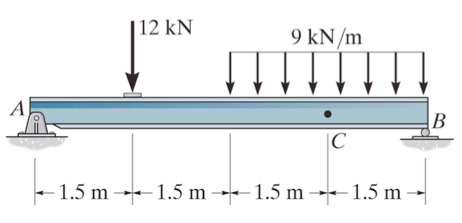
Question: Determine the internal forces (N, V, M) at location C
A blog where I post solutions to the mechanics and statics problems that I encounter. Also many mastering engineering problems will be seen, so users of that program may find this blog interesting. The course uses the Hibbeler Statics textbook and some of the subjects covered include: Cartesian vectors, force resultants, force equilibrium, particle equilibrium, Hooke's Law, vector decomposition, etc. More to be added as those problems and topics are encountered.
Tuesday, October 27, 2015
5_2
Labels:
2D Equilibrium,
7,
Beam,
Distributed Load,
FBD,
Force,
Force Resultant,
Free Body Diagram,
Hinge,
Internal Forces,
Moment,
Pin,
Rigid Body,
Roller,
Simply Supported,
Statics,
Support Reactions
5_1
Labels:
2D Equilibrium,
7,
Beam,
FBD,
Force,
Free Body Diagram,
Hinge,
Internal Forces,
Moment,
Pin,
Rigid Body,
Roller,
Simply Supported,
Statics,
Support Reactions
Wednesday, October 21, 2015
4_1_m
Draw the free-body-diagram and use the force and moment equilibrium to determine the support reactions for the system
Picture:
Labels:
2D Equilibrium,
5,
Beam,
Equilibrium of a Rigid Body,
FBD,
Free Body Diagram,
Hinge,
Pin,
Rigid Body,
Roller,
Support Reactions
4_1_l
Draw the free-body-diagram and use the force and moment equilibrium to determine the support reactions for the system
Picture:
4_1_k
Draw the free-body-diagram and use the force and moment equilibrium to determine the support reactions for the system
Picture:
4_1_j
Draw the free-body-diagram and use the force and moment equilibrium to determine the support reactions for the system
Picture:
4_1_i
Draw the free-body-diagram and use the force and moment equilibrium to determine the support reactions for the system
Picture:
Subscribe to:
Posts (Atom)